
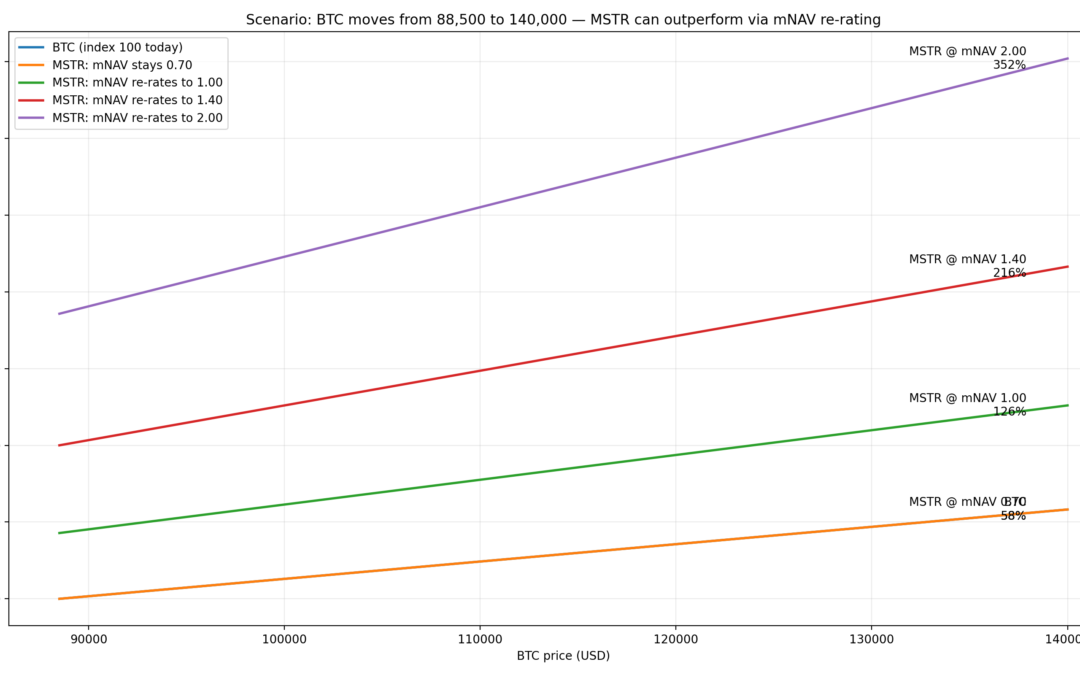
Most people still think of MSTR as “levered Bitcoin.”
That’s incomplete.
What you’re really trading is a two-engine setup.
Engine one is Bitcoin. BTC moves the underlying NAV.
Engine two is the mNAV multiple — the market’s premium (or discount) to that NAV — and that multiple can expand or compress independent of BTC.
That second engine is where things get nonlinear.
If BTC rips, MSTR usually rips harder.
But when BTC rises and mNAV re-rates higher at the same time, MSTR can massively outperform — because you’re getting upside from both the asset and the multiple.
And the flip side matters just as much.
BTC can go up while MSTR goes nowhere if mNAV compresses.
BTC can chop while MSTR bleeds if the premium deflates.
And when both engines turn against you, the stock can feel like a dilution trap.
This post lays out a clean framework for reading that relationship in real time:
What’s inside the full post:
How to think about MSTR as a capital markets flywheel, not a software company.
A simple way to track BTC return vs MSTR return with the mNAV multiple visible (so you can literally see the “multiple” at work).
The “coiled spring” scenario: BTC up + mNAV expansion.
The “silent killer” scenario: BTC up but mNAV compression cancels the move.
How I use this framework to avoid getting chopped when the trade stops paying.
If you trade MSTR without watching mNAV, you’re flying blind.